What Influences a Family's Decision to Move Away in the Face of Community Dissatisfaction?
 Acrimony at political elites, economic dissatisfaction and anxiety about rapid social changes take fueled political upheaval in regions effectually the world in recent years. Anti-establishment leaders, parties and movements have emerged on both the right and left of the political spectrum, in some cases challenging central norms and institutions of liberal democracy. Organizations from Freedom House to the Economist Intelligence Unit to V-Dem have documented global declines in the health of democracy.
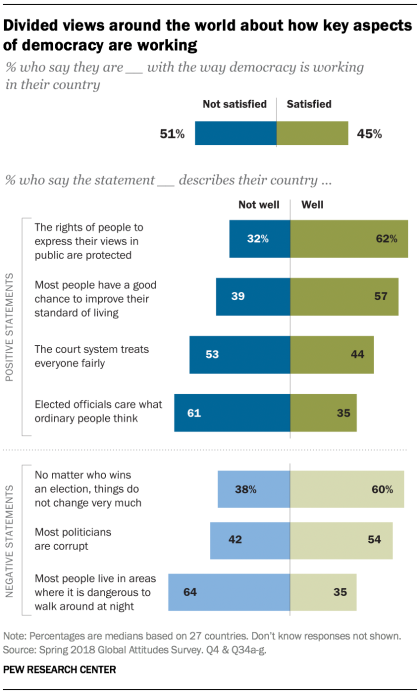
As previous Pew Research Center surveys have illustrated, ideas at the core of liberal democracy remain popular amid global publics, but delivery to democracy can all the same exist weak. Multiple factors contribute to this lack of commitment, including perceptions near how well democracy is operation. And as findings from a new Pew Inquiry Center survey show, views virtually the performance of autonomous systems are decidedly negative in many nations. Beyond 27 countries polled, a median of 51% are dissatisfied with how commonwealth is working in their country; just 45% are satisfied.
Assessments of how well republic is working vary considerably across nations. In Europe, for example, more than half-dozen-in-ten Swedes and Dutch are satisfied with the electric current state of republic, while large majorities in Italy, Espana and Greece are dissatisfied.
To better understand the discontent many feel with commonwealth, we asked people in the 27 nations studied most a variety of economic, political, social and security issues. The results highlight some key areas of public frustration: Most believe elections bring little change, that politicians are decadent and out of touch and that courts do not treat people adequately. On the other hand, people are more positive about how well their countries protect complimentary expression, provide economic opportunity and ensure public safety.
We as well asked respondents near other topics, such as the country of the economy, immigration and attitudes toward major political parties. And in Europe, we included additional questions most immigrants and refugees, also as opinions about the Eu.
Bivariate and multilevel regression analyses (see Appendix A for methodological details) show that, among the factors studied, dissatisfaction with commonwealth is related to economic frustration, the status of individual rights, as well as perceptions that political elites are corrupt and practice not intendance about average citizens. Additionally, in Europe the results advise that dissatisfaction with the way commonwealth is working is tied to views almost the European union, opinions most whether immigrants are adopting national customs and attitudes toward populist parties.
These are among the findings of a Pew Research Center survey conducted among 30,133 people in 27 countries from May 14 to Aug. 12, 2018.
Nosotros measured satisfaction with the performance of democracy in each country using the post-obit question: How satisfied are y'all with the way democracy is working in our country – very satisfied, somewhat satisfied, not likewise satisfied, or not at all satisfied? This question is normally used by academics and on international surveys, including the Global Barometer Surveys.
Satisfaction with democracy can exist thought of equally ane measure of popular delectation – with the current authorities in power or the direction of the nation.1 For example, results of this survey and work by other researchers show that people who back up the party or coalition in power (the "winners") tend to be more satisfied than others.2
The question does not take into business relationship institutional or other features that are sometimes used to characterize a democracy'south wellness. For case, our findings do not necessarily mirror ratings establish in the Republic Index, developed by the Economist Intelligence Unit, or Freedom House'due south Freedom Ratings.
The satisfaction question also does not measure attitudes toward autonomous values or conventionalities in the principles of liberal democracy. That said, scholars have explored the link between views of how democracy is working and delivery to democratic principles. For example, one group of researchers establish that beyond 54 countries, satisfaction with commonwealth was one of the cardinal factors affecting people's normative commitment to democracy.three Our data, too, indicates that the more dissatisfied people are with democracy, the less likely they are to say representative democracy, rather than alternative models like technocracy, a strong leader model, or military rule, is a good way to govern their country (for more on this, encounter Chapter i).
Some scholars also use the question about republic'southward performance to identify "dissatisfied democrats" – those committed to democratic institutions but dissatisfied with the electric current land of commonwealth in their state – a grouping some argue is important for preventing democracies from "back-sliding" into authoritarian regimes.4
______
one Linde, Jonas, and Joakim Ekman. 2003. "Satisfaction with republic: A note on a oftentimes used indicator in comparative politics." European Journal of Political Research.
2 Wells, Jason 1000., and Jonathan Krieckhaus. 2006. "Does National Context Influence Democratic Satisfaction? A Multi-level Assay." Political Research Quarterly.
iii Chu, Yu-ham, Michael Bratton, Marta Lagos, Sandeep Shastri and Mark Tessler. 2008. "Public Stance and Democratic Legitimacy." Journal of Democracy.
4 Norris, Pippa. Ed. 1999. "Critical Citizens: Global Support for Autonomous Authorities."
Economic discontent and democratic dissatisfaction
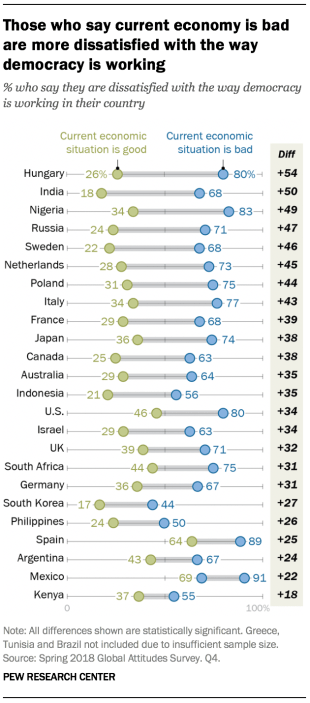 The link between views of the economy and assessments of democratic functioning is strong. In 24 of 27 countries surveyed, people who say the national economic system is in bad shape are more likely than those who say it is in adept shape to be dissatisfied with the way democracy is working. In the other three countries surveyed, so few people say the economy is good that this human relationship cannot be analyzed.
For example, eight-in-ten Hungarians who say the national economical state of affairs is poor are likewise dissatisfied with the operation of the country'southward commonwealth, compared with simply 26% of those who believe the economic situation is good.
Views about economical opportunity likewise play a role. In 26 of 27 nations, those who believe their country is one in which most people cannot improve their standard of living are more likely to be dissatisfied with the way democracy is working.
Even so, personal income is not a major factor. And multilevel regression analysis suggests that, in full general, demographic variables including gender, age and education are not strongly related to democratic dissatisfaction.
Individual rights and democratic functioning
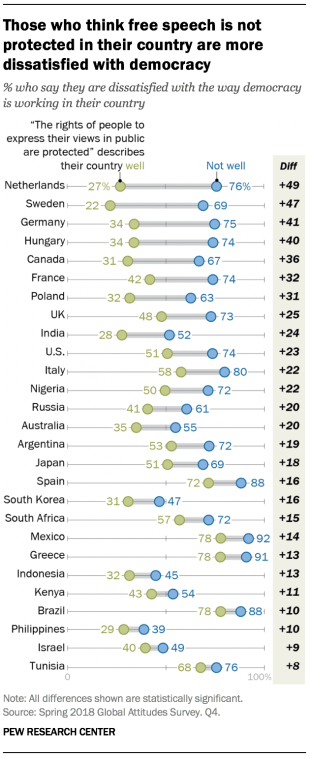 While views about economical conditions have a stiff relationship with assessments of democratic performance, non-economic factors also play an of import role. Opinions almost how well democracy is working in a land are related to whether people believe their most key rights are being respected.
In every nation studied, dissatisfaction with commonwealth is more than common among people who say the statement "the rights of people to limited their views in public are protected" does not depict their country well. This pattern is especially apparent in Europe, where in nations such as the Netherlands, Sweden, Federal republic of germany and Hungary those who believe complimentary expression is not protected are significantly more likely to be unhappy with the country of republic.
Discontent with the functioning of democracy is as well linked to views about how people are treated within a country's justice arrangement. In 24 nations, dissatisfaction is peculiarly common among those who call up the statement "the court system treats everyone adequately" does not describe their land well. Once more, the design is especially intense in Europe. For case, amidst Hungarians who offering a negative assessment of the country's courts, 68% are dissatisfied with the mode democracy is working, while dissatisfaction is only 32% among those who believe the courts treat everyone fairly.
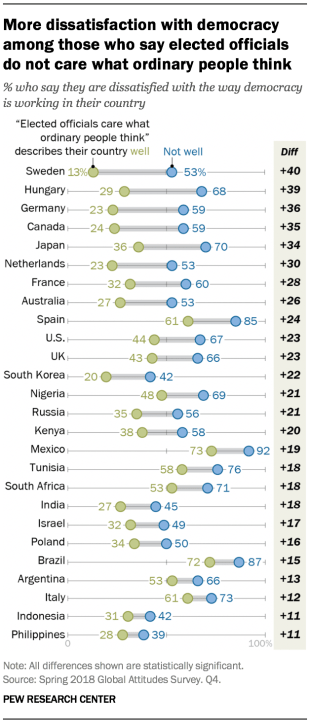 Frustration with politicians breeds dissatisfaction with democracy
In addition to views about political rights, attitudes toward politicians too influence the degree to which people are satisfied or dissatisfied with the operation of their country's commonwealth. For instance, dissatisfaction is pervasive amid people who run into politicians as uncaring and out of touch on.
In 26 nations, unhappiness with the electric current functioning of democracy is more than common among those who believe the argument "elected officials care what ordinary people recollect" does not describe their country well.
Many likewise say the politicians in their country are corrupt, and those who hold this view are consistently more dissatisfied with how their republic is functioning.
Concerns nigh immigrants, dislike of EU and favorable stance of populist parties are tied to dissatisfaction in Europe
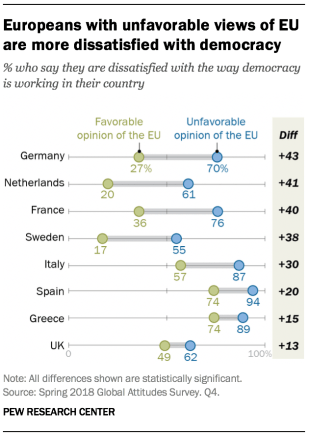 The written report highlights additional factors related to democratic dissatisfaction in Europe, including attitudes toward the European union. As a recent Pew Research Heart study highlighted, Europeans nonetheless tend to acquaintance the Eu with noble aspirations, such as peace, prosperity and commonwealth. At the same time, they also say the Brussels-based institution is inefficient, intrusive and out of touch with ordinary citizens.
Europeans who have a negative view of the Eu also tend to be more dissatisfied with the way democracy is working in their countries than those who view the Eu favorably. The gap is largest in Germany, where those who have an unfavorable opinion of the EU are 43 per centum points more than dissatisfied than those with a favorable stance.
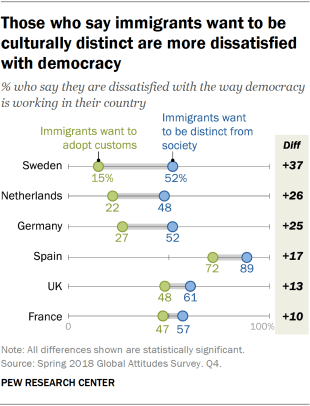 Immigration has been a specially contentious issue in Europe since 2015, when refugees from the Middle East and elsewhere entered Europe in tape numbers. Beyond the region, concerns about how immigrants fit into gild are linked to autonomous dissatisfaction.
In six European countries, those who call up immigrants want to be distinct from order rather than adopting the land'due south customs are more likely to be dissatisfied with democracy. For example, 52% of Swedes who say immigrants want to remain distinct are dissatisfied, compared with just xv% of those who believe immigrants want to adopt Swedish customs.
Anger at the Eu and opposition to immigration accept been consistent themes in the rhetoric and platforms of many right-wing populist parties that have gained support in the by few years. At the same time, Europe has seen the rise of several left-wing populist parties, such every bit La France Insoumise, Espana's Podemos and Greece's ruling Syriza political party.
Overall, populist party sympathizers tend to be unhappy with the mode their democracies are working (parties were classified using the Chapel Hill Expert Survey; for more, see Appendix B). Almost six-in-10 Swedes with a favorable opinion of the Sweden Democrats are dissatisfied with the current country of democracy, compared with only 17% of those who run into the right-wing political party negatively. Similarly, 69% of Germans with a positive view of the right-wing AfD are dissatisfied, while only 37% hold that view among Germans who rate AfD negatively.
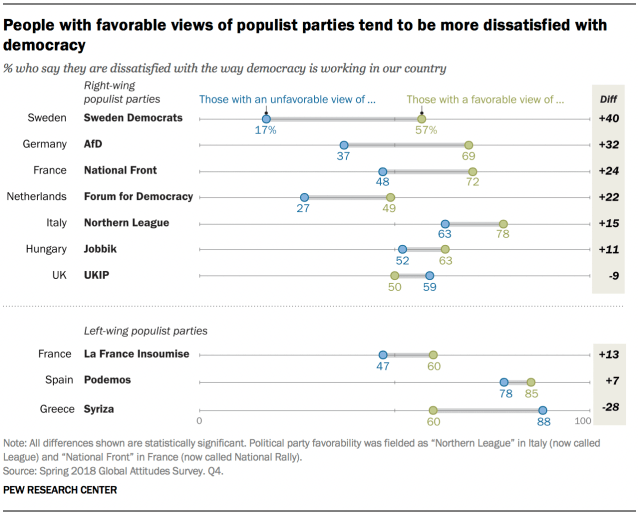
The aforementioned pattern is found amid those who sympathize with left-wing populist parties in some nations. For example, six-in-x who accept a favorable view of La French republic Insoumise are dissatisfied with how commonwealth is working, compared with 47% of French people who see the political party negatively.
Interestingly, those with favorable opinions of 2 European populist parties are more satisfied with how democracy is working: the Britain's correct-wing, pro-Brexit UKIP and Greece'south left-wing Syriza.
Source: https://www.pewresearch.org/global/2019/04/29/many-across-the-globe-are-dissatisfied-with-how-democracy-is-working/
0 Response to "What Influences a Family's Decision to Move Away in the Face of Community Dissatisfaction?"
Post a Comment