The Name of the Art Produced in Early Medieval Monasteries in Ireland and Britain
The Early Middle Ages
The Early on Heart Ages began with the fall of the Roman Empire and ended in the early 11th century; its fine art encompasses vast and divergent forms of media.
Learning Objectives
Identify the major periods and styles into which European art of the Early Middle Ages is classified, and artistic elements common to all of them
Fundamental Takeaways
Primal Points
- "Medieval fine art" applies to various media , including sculpture, illuminated manuscripts , tapestries , stained glass, metalwork , and mosaics .
- Early medieval fine art in Europe is an amalgamation of the artistic heritage of the Roman Empire, the early on Christian church, and the "barbarian" artistic culture of Northern Europe.
- Despite the wide range of media, the use of valuable and precious materials is a abiding in medieval art. Many artworks characteristic the lavish utilise of gold, jewels, expensive pigments , and other precious appurtenances.
- A rising in illiteracy during the Early Eye Ages resulted in the need for art to convey circuitous narratives and symbolism . As a consequence, fine art became more stylized , losing the classical naturalism of Graeco-Roman times, for much of the Heart Ages.
- Few big stone buildings were constructed between the Constantinian basilicas of the fourth and eighth centuries. Past the late eighth century, the Carolingian Empire revived the basilica form of architecture.
The Middle Ages of the European world covers approximately ane,000 years of art history in Europe, and at times extended into the Middle East and Due north Africa. The Early Middle Ages is generally dated from the fall of the Western Roman Empire (476 CE) to approximately chiliad, which marks the beginning of the Romanesque menstruation. It includes major art movements and periods, national and regional art, genres , and revivals. Art historians attempt to classify medieval art into major periods and styles with some difficulty, equally medieval regions frequently featured distinct artistic styles such as Anglo-Saxon or Norse . Even so, a generally accepted scheme includes Early Christian art, Migration Period fine art, Byzantine art, Insular art , Carolingian fine art, Ottonian art, Romanesque art , and Gothic art, as well equally many other periods within these central artful styles.
Population decline, relocations to the countryside, invasion, and migration began in Late Antiquity and continued in the Early Heart Ages. The big-scale movements of the Migration Period, including various Germanic peoples, formed new kingdoms in what remained of the Western Roman Empire. In the West, almost kingdoms incorporated the few extant Roman institutions. Monasteries were founded as campaigns to Christianize pagan Europe connected. The Franks, under the Carolingian dynasty , briefly established the Carolingian Empire during the after eighth and early ninth century. Information technology covered much of Western Europe simply later succumbed to the pressures of internal civil wars combined with external invasions—Vikings from the north, Hungarians from the eastward, and Saracens from the south.
Equally literacy declined and printed material became available merely to monks and nuns who copied illuminated manuscripts, art became the primary method of communicating narratives (usually of a Biblical nature) to the masses . Conveying complex stories took precedence over producing naturalistic imagery , leading to a shift toward stylized and abstracted figures for virtually of the Early Middle Ages. Brainchild and stylization also appeared in imagery attainable but to select communities, such as monks in remote monasteries like the complex at Lindisfarne off the declension of Northumberland, England.
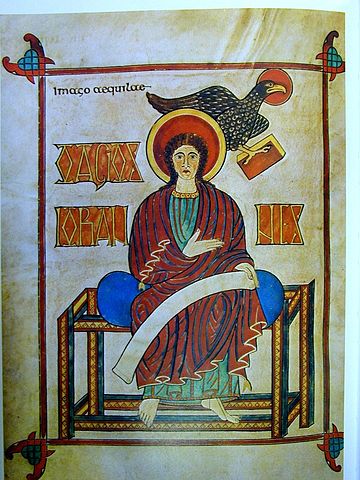
John the Evangelist folio from the Lindisfarne Gospels (c. 635 CE): As is common in early medieval art, the figures in this folio appear apartment and stylized. The bench on which John sits does non recede realistically into the space behind him. Modeling is kept to a minimum, and the clothing that John wears does not acknowledge the body beneath.
Early medieval art exists in many media. The works that remain in big numbers include sculpture, illuminated manuscripts, stained drinking glass, metalwork, and mosaics, all of which have had a higher survival rate than fresco wall-paintings and works in precious metals or textiles such as tapestries. In the early medieval period, the decorative arts, including metalwork, ivory carving, and embroidery using precious metals, were probably more highly valued than paintings or sculptures. Metal and inlaid objects, such equally armor and purple regalia (crowns, scepters, and the like) rank amongst the best-known early medieval works that survive to this day.

Visigoth votive crown (before 672 CE).: Particular of a votive crown from Visigothic Spain. Gold and precious stones. Part of the Treasure of Guarrazar.
Early medieval art in Europe grew out of the creative heritage of the Roman Empire and the iconographic traditions of the early Christian church building. These sources were mixed with the vigorous "Barbaric" artistic civilization of Northern Europe to produce a remarkable artistic legacy. The history of medieval fine art can be seen as an ongoing coaction between the elements of classical, early Christian, and "barbarian" fine art. Apart from the formal aspects of classicism, there was a continuous tradition of realistic depiction that survived in Byzantine art of Eastern Europe throughout the period. In the Westward realistic presentation appears intermittently, combining and sometimes competing with new expressionist possibilities. These expressionistic styles developed both in Western Europe and in the Northern aesthetic of energetic decorative elements.
Monks and monasteries had a deep effect on the religious and political life of the Early on Middle Ages, in diverse cases acting equally land trusts for powerful families, centers of propaganda and royal support in newly conquered regions, and bases for missions and proselytizing. They were the main and sometimes only regional outposts of didactics and literacy. Many of the surviving manuscripts of the Latin classics were copied in monasteries in the Early Middle Ages. Monks were also the authors of new works, including history, theology, and other subjects written by authors such as Bede (died 735), a native of northern England who wrote in the late seventh and early eighth centuries.
The utilize of valuable materials is a constant in medieval art. Most illuminated manuscripts of the Early on Middle Ages had lavish book covers decked with precious metal, ivory, and jewels. One of the best examples of precious metalwork in medieval fine art is the jeweled comprehend of the Codex Aureus of St. Emmeram (c. 870). The Codex, whose origin is unknown, is decorated with gems and gold relief . Gold was also used to create sacred objects for churches and palaces, equally a solid groundwork for mosaics, and applied every bit gold leaf to miniatures in manuscripts and console paintings. Named afterwards Emmeram of Regensburg and lavishly illuminated, the Codex is an of import instance of Carolingian fine art, equally well of one of very few surviving treasure bindings of the late ninth century.

Cover of the Codex Aureus : Gold and gem-encrusted embrace of the Codex Aureus of St. Emmeram, 870. Munich, Bayerische Staatsbibliothek, Clm 14000.
Few large stone buildings were constructed between the Constantinian basilicas of the fourth and eighth centuries, although many smaller ones were built during the 6th and 7th centuries. By the early eighth century, the Merovingian dynasty revived the basilica form of architecture. One feature of the basilica is the employ of a transept , the "arms" of a cross-shaped edifice that are perpendicular to the long nave . Other new features of religious architecture include the crossing tower and a monumental entrance to the church, commonly at the due west terminate of the edifice.

Charlemagne's Palatine Chapel at Aachen (consecrated 805 CE).: The Palatine Chapel is an instance of Charlemegne's attempt to revive the values of the Roman Empire under the banner of Christianity. While the program predates the cruciform basilica, it revives the classical round arch and heavy stone masonry every bit well as the east-facing alcove of Belatedly Antiquity.
Architecture under the Merovingians
Merovingian architecture emerged under the Merovingian Frankish dynasty and reflected a fusion of Western and Eurasian influences.
Learning Objectives
Describe some basic elements of Merovingian architecture
Primal Takeaways
Key Points
- Merovingian compages often continued the Roman basilica tradition, but also adopted influences from as far away every bit Syria and Armenia.
- Many Merovingian churches no longer be. One surviving church building is Saint-Pierre-aux-Nonnains at Metz, originally built every bit a Roman gymnasium in the late 4th century and reappropriated into a church in the mid-eighth century.
- Some minor Merovingian structures remain, especially baptisteries, which were spared rebuilding in afterward centuries.
- The Baptistery at Saint-Leonce of Fréjus, highlights the influence of Syrian technique on Merovingian compages, evidenced past its octagonal shape and a covered cupola on pillars . On the other hand, St. Jean at Poitiers is very dissimilar from the Baptistery at Saint-Leonce of Fréjus, as information technology has the form of a rectangle flanked by three apses .
- Although mostly reconstructed, the interior of the baptistery of Saint-Sauveur reveals the influence of Roman architecture on Merovingian architects.
Key Terms
- the Baptistery at Saint-Leonce of Fréjus: A structure that highlights the influence of Syrian technique on Merovingian compages.
- the basilica of Saint Martin at Tours: One of the nearly famous examples of Merovingian church building architecture, congenital at the beginning of the dynasty'south reign.
- Merovingian dynasty: A Frankish family who ruled parts of present-day France, Belgium, the Netherlands, Luxembourg, and parts of Germany from the mid-fifth century to the mid-eighth century.
Merovingian architecture developed under the Merovingian dynasty , a Frankish family who ruled parts of present-day France, Belgium, the netherlands, Grand duchy of luxembourg, and parts of Germany from the mid-5th century to the mid-eighth century. The advent of the Merovingian dynasty in Gaul led to important changes in compages.
The unification of the Frankish kingdom nether Clovis I (465–511) and his successors corresponded with the need for new churches. Merovingian architecture often connected the Roman basilica tradition, simply too adopted influences from as far away as Syria and Armenia. In the Due east, almost structures were in timber , but stone was more common for significant buildings in the Westward and in the southern areas that later fell under Merovingian dominion.
Many Merovingian churches no longer exist. One famous example is the basilica of Saint Martin at Tours, at the showtime of Merovingian dominion and at the time on the edge of Frankish territory. According to scholars, the church had 120 marble columns , towers at the e finish, and several mosaics . A characteristic of the basilica of Saint-Martin that became a authentication of Frankish church architecture was the sarcophagus or reliquary of the saint, raised to be visible and sited axially behind the altar, sometimes in the apse. There are no Roman precedents for this Frankish innovation. A number of other buildings now lost, including the Merovingian foundations of Saint-Denis, St. Gereonin Cologne, and the Abbey of Saint-Germain-des-Prés in Paris, are described as similarly ornate.
One surviving church is Saint-Pierre-aux-Nonnains at Metz. The building was originally built in 380 CE as a gymnasium (a European type of school) for a Roman spa complex. In the seventh century, the construction was converted into a church, becoming the chapel of a Benedictine convent. The structure bears common hallmarks of a Roman basilica, including the round arches and tripartite division into nave (eye) and aisles (left and right of the nave), a sectionalization visible from the exterior of the edifice. Plain missing, however, is the apse.

Saint-Pierre-aux-Nonnains: This church in Metz, France bears common hallmarks of a Roman basilica, including the round arches and tripartite division into nave (center) and aisles (left and right of the nave), a division visible from the exterior of the building.
Other major churches have been rebuilt, usually more than in one case. Nevertheless, some small Merovingian structures remain, especially baptisteries, which were spared rebuilding in later centuries. For example, the Baptistery at Saint-Leonce of Fréjus, highlights the influence of Syrian technique on Merovingian architecture, evidenced by its octagonal shape and covered cupola on pillars.

Baptistery at Saint-Léonce of Fréjus: The Baptistery at the cathedral at Saint-Léonce of Fréjus reflects the Syrian and Armenian influences on early Merovingian compages (demonstrated by the cupola on pillars).
By contrast , St. Jean at Poitiers has the form of a rectangle flanked by 3 apses. The original edifice has probably had a number of alterations but preserves traces of Merovingian influence in its marble capitals .

Baptistry of Saint-Jean of Poitiers: The Baptistry of St. Jean at Poitiers (6th century) has the course of a rectangle flanked by three apses. The original building has probably undergone a number of alterations but preserves in its ornament (marble capitals) a strong Merovingian character.
The baptistery of Saint-Sauveur at Aix-en-Provence was built at the kickoff of the 6th century, at about the same time as like baptisteries in Fréjus Cathedral and Riez Cathedral in Provence, in Albenga, Liguria, and in Djémila, Algeria. Only the octagonal baptismal pool and the lower part of the walls remain from that period. The other walls, Corinthian columns, arcade , and dome were rebuilt in the Renaissance . A viewing pigsty in the floor reveals the bases of the porticoes of the Roman forum under the baptistery.

Baptistery of Saint-Sauveur: Although generally reconstructed, the interior of the baptistery reveals the influence of Roman architecture on Merovingian architects.
By the seventh century, Merovingian craftsmen were brought to England for their drinking glass-making skills, and Merovingian stonemasons were used to build English churches, suggesting that the civilisation's ornamental arts were highly regarded by neighboring peoples.
Anglo-Saxon and Irish Art
Celtic and Anglo-Saxon art display like aesthetic qualities and media, including architecture and metalwork.
Learning Objectives
Compare elements of Anglo-Saxon and Celtic art
Central Takeaways
Fundamental Points
- Anglo-Saxon fine art emerged when the Anglo-Saxons migrated from the continent in the 5th century and concluded in 1066 with the Norman Conquest. Anglo-Saxon fine art, which favored brightness and color, survives mostly in architecture and metalwork .
- The Sutton Hoo burial site contains the best known examples of Anglo-Saxon metalwork, showing the masterful craftsmanship of items such equally armor and ornamental objects.
- The architectural character of Anglo-Saxon ecclesiastical buildings range from influence from Celtic and Early Christian styles . Subsequently Anglo-Saxon architecture is characterized past pilasters , blank arcading, baluster shafts and triangular-headed openings.
- Celtic art is ornamental, avoiding straight lines , only occasionally using symmetry , and oftentimes involving circuitous symbolism . Celtic art has used a variety of styles and equally shown influences from other cultures in knotwork, spirals, central patterns, lettering, and human being figures.
- With the arrival of Christianity, Celtic art was influenced by both Mediterranean and Germanic traditions, creating the Insular style. The interlace patterns that are typical of Celtic art were in fact introduced to Insular art from the Mediterranean and Migration artistic traditions.
Fundamental Terms
- Insular Fine art: Art produced in the post-Roman history of the British Isles, also known every bit Hiberno-Saxon fine art. The term derives from the Latin term for island. Uk and Republic of ireland shared a common style that differed from that of the balance of Europe in this period.
Anglo-Saxon art emerged when the Anglo-Saxons migrated from the continent in the fifth century and ended in 1066 with the Norman Conquest. Anglo-Saxon art, which favored effulgence and color, survives mostly in architecture and metalwork.
Anglo-Saxon Metalwork
Anglo-Saxon metalwork consisted of Germanic-style jewelry and armor, which was normally placed in burials. After the conversion of the Anglo-Saxons to Christianity in the seventh century, the fusion of Germanic Anglo-Saxon, Celtic, and Early on Christian techniques created the Hiberno-Saxon style (or Insular art) in the form of sculpted crosses and liturgical metalwork. Insular art is characterized by detailed geometric designs, interlace, and stylized beast ornament.
Anglo-Saxon metalwork initially used the Germanic Beast Way ornament that would be expected from recent immigrants, just gradually adult a distinctive Anglo-Saxon character. For example, circular disk brooches were preferred for the grandest Anglo-Saxon pieces, over continental styles of fibulae and Romano-British penannular brooches. Decoration included cloisonné ("cellwork") in gold and garnet for high-status pieces. Despite a considerable number of other finds, the discovery of the ship burial at Sutton Hoo transformed the history of Anglo-Saxon art, showing a level of sophistication and quality that was wholly unexpected at this date. Amidst the most famous finds from Sutton Hoo are a helmet and an ornamental purse lid.

Sutton Hoo helmet (reconstruction): The Sutton Hoo helmet features an atomic number 26 skull of a single vaulted trounce and has a full face mask, a solid neck guard, and deep cheekpieces. These features advise an English origin for the bones structure of the helmet. Although outwardly similar to the Swedish examples, the Sutton Hoo helmet is a production of better craftsmanship. This reconstruction in the Imperial Armouries shows the intricate jeweled inlay, repoussé reliefs, and abstruse designs that once adorned the original.

Sutton Hoo Purse Lid: This ornamental purse lid covered a lost leather pouch, hung from a waist belt. The forms on the height row feature interlace typical of Insular art, while the bottom row features stylized humans and mythical animals either devouring or beingness devoured.
Anglo-Saxon Architecture
Anglo-Saxon secular buildings in Britain were more often than not elementary, constructed mainly using timber with thatch for roofing. No universally accepted example survives aboveground. There are, however, many remains of Anglo-Saxon church building compages. At least fifty churches of Anglo-Saxon origin display the civilization's major architectural features, although in some cases these aspects are modest and significantly altered. The round-belfry church and tower-nave church are distinctive Anglo-Saxon types. All surviving churches, except ane timber church building, are congenital of stone or brick, and in some cases prove prove of reused Roman piece of work.

Fobbing Parish Church, section of outer wall.: Blocked Anglo-Saxon circular-arched window at Fobbing Parish Church. Besides visible is the textured stone work of the outer wall.
The architectural character of Anglo-Saxon ecclesiastical buildings range from influence from Celtic and Early Christian styles. Later Anglo-Saxon compages is characterized by pilasters, blank arcading, baluster shafts and triangular-headed openings. In the final decades of the Anglo-Saxon kingdom a more general Romanesque mode was introduced from the Continent, equally in the additions to Westminster Abbey fabricated from 1050 onwards.

Anglo-Saxon church building at Reculver: Triple arch opening separating the nave and apse in the 7th-century church at Reculver, Kent (now destroyed). This reconstruction shows the blank arcading that was mutual in Anglo-Saxon architecture.
Celtic Fine art
"Celtic art" refers to the art of people who spoke Celtic languages in Europe and those with uncertain language but cultural and stylistic similarities with Celtic speakers. Typically, Celtic art is ornamental, avoiding straight lines, only occasionally using symmetry, and often involving complex symbolism. Celtic art has used a variety of styles and has shown influences from other cultures in knotwork, spirals, key patterns, lettering, and human figures.
Around 500 BCE, the La Tène mode appeared rather all of a sudden, coinciding with some kind of societal upheaval that involved a shift of the major centers to the northwest. La Tène was especially prominent in northern France and western Deutschland, only over the side by side three centuries the style spread every bit far as Ireland, Italy, and modern Hungary. Early La Tène style adapted ornamental motifs from foreign cultures, including Scythian, Greek, and Etruscan arts. La Tène is a highly stylized curvilinear art based mainly on classical vegetable and foliage motifs such as leafy palmette forms, vines, tendrils, and lotus flowers together with spirals, S-scrolls, lyre , and trumpet shapes. It remains uncertain whether some of the almost notable objects found from the La Tène period were made in Republic of ireland or elsewhere (as far away as Egypt in some cases). But in Scotland and the western parts of United kingdom, versions of the La Tène way remained in use until it became an important component of the Insular style that developed to meet the needs of newly Christian populations.
Celtic fine art in the medieval period was produced by the people of Republic of ireland and parts of Britain over the course of 700 years. With the arrival of Christianity, Celtic art was influenced by both Mediterranean and Germanic traditions, primarily through Irish gaelic contact with Anglo-Saxons, which resulted in the Insular style. The interlace patterns that are regarded as typical of Celtic fine art were in fact introduced from the Mediterranean and Migration Period artistic traditions. Specific examples of Celtic Insular art include the Tara Brooch and the Ardagh Chalice.

Tara Brooch, forepart view: Created in about 700 CE, the seven-inch long pseudo-penannular brooch is composed primarily of silver gilt and embellished with intricate abstruse decoration including interlace on both the front and dorsum.

The Ardagh Chalice: The Ardagh Chalice reflects the interlace styles introduced into the Celtic Insular Art class from the Mediterranean.
Cosmic Celtic sculpture began to flourish in the form of the large stone crosses that held biblical scenes in carved relief . This art form reached its apex in the early 10th century, with Muiredach's Cantankerous at Monasterboice and the Ahenny Loftier Cantankerous.

Ahenny High Cross (700-800 CE): Ahenny High Cross, Ireland, ane of the principal examples of Celtic sculpture.
Illustrated Books in the Early Middle Ages
Insular art is ofttimes characterized by detailed geometric designs, interlace, and stylized animal decorations in illuminated manuscripts.
Learning Objectives
Describe the history and characteristics of illuminated manuscripts in Insular art
Key Takeaways
Key Points
- An illuminated manuscript features text supplemented by elaborate decoration. The term is mostly used to refer to any decorated or illustrated manuscript from the Western tradition. Illuminated manuscripts were written on vellum , and some characteristic the use of precious metals and pigments that were imported to northern Europe.
- Insular art is characterized by detailed geometric designs, interlace,
and stylized beast ornament spread boldly across illuminated
manuscripts. Insular manuscripts sometimes have a whole page for a
single initial or the offset few words at beginnings of gospels. - The Book of Kells is considered a masterwork of Western calligraphy , with its illustrations and ornamentation surpassing that of other Insular Gospel books in complexity. The Kells manuscript's ornamentation combines traditional Christian iconography with the ornate swirling Insular motifs .
- Anglo-Saxon illuminated manuscripts, such as the Stockholm Codex Aureus, combine Insular art with Italian styles such as classicism.
- Mozarabic art refers to fine art of Mozarabs, Iberian Christians living in Al-Andalus who adopted Arab community without converting to Islam during the Islamic invasion of the Iberian peninsula. It features a combination of (Hispano) Visigothic, and Islamic art styles, equally in the Beatus manuscripts , which combine Insular fine art illumination forms with Arabic-influenced geometric designs.
Key Terms
- parchment: A material fabricated from the polished skin of a dogie, sheep, caprine animal or other brute, used every bit writing newspaper.
- Mozarabic: Art of Iberian Christians living in Al-Andalus, the Muslim-conquered territories, after the Arab invasion of the Iberian Peninsula (711 CE) to the end of the 11th century. These people adopted some Arab customs without converting to Islam, preserving their religion and some ecclesiastical and judicial autonomy.
- Book of Kells: An illuminated manuscript in Latin containing the iv Gospels of the New Testament together with various prefatory texts and tables. Information technology was created by Celtic monks circa 800 or slightly before.
- Insular Art: Art produced in the post-Roman history of the British Isles, also known as Hiberno-Saxon art. The term derives from the Latin term for island. Britain and Republic of ireland shared a common style that differed from that of the rest of Europe.
- illuminated manuscript: A volume in which the text is supplemented by decoration, such as initials, borders (marginalia), and miniature illustrations.
Background
An illuminated manuscript contains text supplemented by the addition of ornament, such equally decorated initials, borders (marginalia), and miniature illustrations. In the strict definition of the term, an illuminated manuscript indicates just those manuscripts busy with gold or silver. However, the term is now used to refer to any busy manuscript from the Western tradition. The earliest surviving substantive illuminated manuscripts are from the period 400 to 600 CE and were initially produced in Italy and the Eastern Roman Empire. The significance of these works lies not only in their inherent art historical value , but also in the maintenance of literacy offered by not-illuminated texts every bit well. Had it non been for the monastic scribes of Late Antiquity who produced both illuminated and non-illuminated manuscripts, about literature of ancient Greece and Rome would have perished in Europe.
The majority of surviving illuminated manuscripts are from the Heart Ages , and hence most are of a religious nature. Illuminated manuscripts were written on the all-time quality of parchment , chosen vellum. By the sixteenth century, the introduction of printing and paper rapidly led to the decline of illumination, although illuminated manuscripts continued to be produced in much smaller numbers for the very wealthy. Early on medieval illuminated manuscripts are the all-time examples of medieval painting, and indeed, for many areas and fourth dimension periods, they are the only surviving examples of pre-Renaissance painting.
Insular Art in Illustrated Books
Deriving from the Latin word for isle (insula), Insular fine art is characterized past detailed geometric designs, interlace, and stylized animal decoration spread boldly beyond illuminated manuscripts. Insular manuscripts sometimes have a whole page for a single initial or the first few words at beginnings of gospels. The technique of assuasive decoration the right to roam was later influential on Romanesque and Gothic fine art. From the seventh through ninth centuries, Celtic missionaries traveled to Britain and brought the Irish tradition of manuscript illumination, which came into contact with Anglo-Saxon metalworking. New techniques employed were filigree and chip-etching, while new motifs included interlace patterns and animal ornamentation.
The Volume of Kells (Irish: Leabhar Cheanannais), created by Celtic monks in 800, is an illustrated manuscript considered the pinnacle of Insular art. Also known every bit the Book of Columba, The Book of Kellsis considered a masterwork of Western calligraphy, with its illustrations and ornamentation surpassing that of other Insular Gospel books in extravagance and complexity. The Book of Kells's decoration combines traditional Christian iconography with the ornate swirling motifs typical of Insular fine art. Figures of humans, animals, and mythical beasts, together with Celtic knots and interlacing patterns in vibrant colors, enliven the manuscript's pages. Many of these minor decorative elements are imbued with Christian symbolism . The manuscript comprises 340 folios made of high-quality vellum and unprecedentedly elaborate ornamentation including 10 full-page illustrations and text pages vibrant with decorated initials and interlinear miniatures. These mark the furthest extension of the anti- classical and energetic qualities of Insular fine art.

Book of Kells: Folio 27v: Folio 27v contains the symbols of the Four Evangelists (clockwise from top left): a human (Matthew), a lion (Marking), an eagle (John), and an ox (Luke). The Evangelists are placed in a grid and enclosed in an arcade, as is common in the Mediterranean tradition. Even so, discover the elaborate geometric and stylized decoration in the arcade that highlights the Insular artful.
The Insular majuscule script of the text itself in the Book of Kells appears to exist the work of at least three dissimilar scribes. The lettering is in fe gall ink with colors derived from a wide range of substances, many of which were imported from distant lands. The text is accompanied by many full-page miniatures, while smaller painted decorations appear throughout the text in unprecedented quantities. The decoration of the book is famous for combining intricate detail with bold and energetic compositions . The illustrations characteristic a broad range of colors, most oft purple, lilac, cerise, pink, light-green, and xanthous. As typical with Insular piece of work, there was neither gold nor argent leafage in the manuscript. However, the pigments for the illustrations, which included crimson and yellowish ochre , green copper pigment (sometimes chosen verdigris), indigo , and lapis lazuli , were very costly and precious. They were imported from the Mediterranean region and, in the instance of the lapis lazuli, from northeast Afghanistan.
The ornamentation of the first eight pages of the canon tables is heavily influenced by early Gospel Books from the Mediterranean, where information technology was traditional to enclose the tables within an arcade . Although influenced by this Mediterranean tradition, the Kells manuscript presents this motif in an Insular spirit, where the arcades are non seen as architectural elements merely rather go stylized geometric patterns with Insular decoration. Further, the complicated knot work and interweaving found in the Kells manuscript echo the metalwork and stone carving works that characterized the artistic legacy of the Insular period.

The Book of Kells: This example from the manuscript (folio 292r) shows the lavishly busy department that opens the Gospel of John.
Anglo-Saxon illuminated manuscripts form a meaning part of Insular fine art and reflect a combination of influences from the Celtic styles that arose when the Anglo-Saxons encountered Irish missionary activity. A different mixture is seen in the opening from the Stockholm Codex Aureus, where the evangelist portrait reflects an accommodation of classical Italian style, while the text page is mainly in Insular style, particularly the offset line with its vigorous Celtic spirals and interlace. This is ane of the so-called "Tiberius Group" of manuscripts with influence from the Italian manner. It is the final English manuscript in which trumpet spiral patterns are found.

The Stockholm Codex Aureus: The evangelist portrait from the Stockholm Codex Aureus, 1 of the "Tiberius Group," that shows the Insular style and classicizing continental styles that combined and competed in early Anglo-Saxon manuscripts.
The Beatus Manuscripts
The Commentary on the Apocalypse was originally a Mozabaric 8th-century work by the Spanish monk and theologian Beatus of Liébana. Oft referred to simply every bit the Beatus, it is used today to reference any of the extant manuscript copies of this work, especially any of the 26 illuminated copies that accept survived. The historical significance of the Commentary is fifty-fifty more than pronounced since it included a world map, offering a rare insight into the geographical agreement of the post-Roman globe. Considered together, the Beatus codices are amidst the most important Castilian and Mozarabic medieval manuscripts and have been the subject of all-encompassing scholarly and antiquarian inquiry.

Beatus World Map: The world map from the Saint-Sever Beatus, measuring 37 x 57 cm. This was painted c. 1050 as an illustration to Beatus's piece of work at the Abbey of Saint-Sever in Aquitaine, on the society of Gregori de Montaner, Abbot from 1028 to 1072.
Though Beatus might accept written these commentaries every bit a response to Adoptionism in the Hispania of the late 700s, many scholars believe that the volume's popularity in monasteries stemmed from the Arabic-Islamic conquest of the Iberian peninsula, which some Iberian Christians took as a sign of the Antichrist. Not all of the Beatus manuscripts are complete, and some exist only in bitty form. However, the surviving manuscripts are lavishly decorated in the Mozarabic, Romanesque, or Gothic manner of illumination.
Mozarabic art refers to art of Mozarabs, Iberian Christians living in Al-Andalus who adopted Arab customs without converting to Islam during the Islamic invasion of the Iberian peninsula (from the eighth through the 11th centuries). Mozarabic art features a combination of (Hispano) Visigothic and Islamic art styles, as in the Beatus manuscripts, which combine Insular art illumination forms with Arabic-influenced geometric designs.

Beatus of Liébana. Sentence of Babylon. : From Beatus Apocalypse. Depicts Babylon on fire using Insular art illumination forms, influenced past Arabic geometric designs.
Source: https://courses.lumenlearning.com/boundless-arthistory/chapter/the-early-middle-ages/
0 Response to "The Name of the Art Produced in Early Medieval Monasteries in Ireland and Britain"
Post a Comment