Ryans Being a Little Birch Again Meme
Recent alterations to violent groups in the United states of america and to the limerick of the two main political parties accept created a latent force for violence that can be ane) triggered past a multifariousness of social events that touch on a number of interrelated identities; or ii) purposefully ignited for partisan political purposes. This essay describes the history of such forces in the U.S., shares the risk factors for election violence globally and how they are trending in the U.S., and concludes with some potential paths to mitigate the problem.
One week after the 2022 U.S. presidential election, Eric Coomer, an executive at Dominion Voting Systems, was forced into hiding. Angry supporters of then-president Donald Trump, believing false accusations that Dominion had switched votes in favor of Joe Biden, published Coomer'south home address and phone number and put a 1000000-dollar bounty on his head. Coomer was one of many people in the crosshairs. An unprecedented number of elections administrators received threats in 2020—and so much so that a third of poll workers surveyed by the Brennan Centre for Justice in April 2022 said that they felt dangerous and 79 percent wanted government-provided security. In July, the Department of Justice prepare up a special task force specifically to combat threats confronting ballot administrators.ane
From decease threats against previously anonymous bureaucrats and public-wellness officials to a plot to kidnap Michigan's governor and the 6 Jan 2022 attack on the U.S. Capitol, acts of political violence in the United States take skyrocketed in the last v years.two The nature of political violence has too changed. The media's focus on groups such as the Proud Boys, Adjuration Keepers, and Boogaloo Bois has obscured a deeper trend: the "ungrouping" of political violence as people self-radicalize via online date. According to the National Consortium for the Written report of Terrorism and Responses to Terrorism (START), which maintains the Global Terrorism Database, most political violence in the United states of america is committed by people who practice non belong to any formal organization.
Instead, ideas that were one time confined to fringe groups now appear in the mainstream media. White-supremacist ideas, militia fashion, and conspiracy theories spread via gaming websites, YouTube channels, and blogs, while a slippery linguistic communication of memes, slang, and jokes blurs the line between posturing and provoking violence, normalizing radical ideologies and activities.
These shifts accept created anew reality: millionsof Americans willing to undertake, support, or excuse political violence, defined here (following the violence-prevention organization Over Nil) as physical harm or intimidation that affects who benefits from or tin can participate fully in political, economical, or sociocultural life. Violence may be catalyzed by predictable social events such equally Black Lives Matter protests or mask mandates that trigger a sense of threat to a common shared identity. Violence can likewise be intentionally wielded as a partisan tool to affect elections and commonwealth itself. This organizational blueprint makes stopping political violence more than difficult, and also more than crucial, than e'er before.
Political Violence in the United states Historically
Political violence has a long history in the U.s.. Since the belatedly 1960s, it was carried out byintensely ideological groups that pulled adherents out of the mainstream into clandestine cells, such as the anti-imperialist Weather Hole-and-corner Organization or the anti-ballgame Operation Rescue. In the belatedly 1960s and 1970s, these violent fringes were mostly on the far left. They committed extensive violence, largely against property (with notable exceptions), in the name of social, environmental, and creature-rights causes. Starting in the late 1970s, political violence shifted rightward with the ascent of white supremacist, anti-abortion, and militia groups. The number of vehement events declined, but targets shifted from property to people—minorities, abortion providers, and federal agents.
What is occurring today does not resemble this recent past. Although incidents from the left are on the rise, political violence all the same comes overwhelmingly from the right, whether 1 looks at the Global Terrorism Database, FBI statistics, or other government or contained counts.3 However people committing far-correct violence—particularly planned violence rather than spontaneous hate crimes—are older and more established than typical terrorists and violent criminals. They often hold jobs, are married, and have children. Those who attend church or belong to community groups aremore likely to hold violent, conspiratorial beliefs.four These are not isolated "alone wolves"; they are function of a wide community that echoes their ideas.
Ii subgroups appear most decumbent to violence. The Jan 2022 American Perspectives Survey found that white Christian evangelical Republicans were outsized supporters of both political violence and the Q-Betimes conspiracy, which claims that Autonomous politicians and Hollywood elites are pedophiles who (aided by mask mandates that hinder identification) traffic children and harvest their blood; separate polls by evangelical political scientists found that in October 2022 approximately 47 percent of white evangelical Christians believed in the tenets of Q-Anon, as did 59 percent of Republicans.5 Many evangelical pastors are working to turn their flocks away from this heresy. The details appear outlandish, only stripped to its core, the broad entreatment becomes clearer: Democrats and cultural elites are often portrayed equally Satanic forces arrayed against Christianity and seeking to harm Christian children.
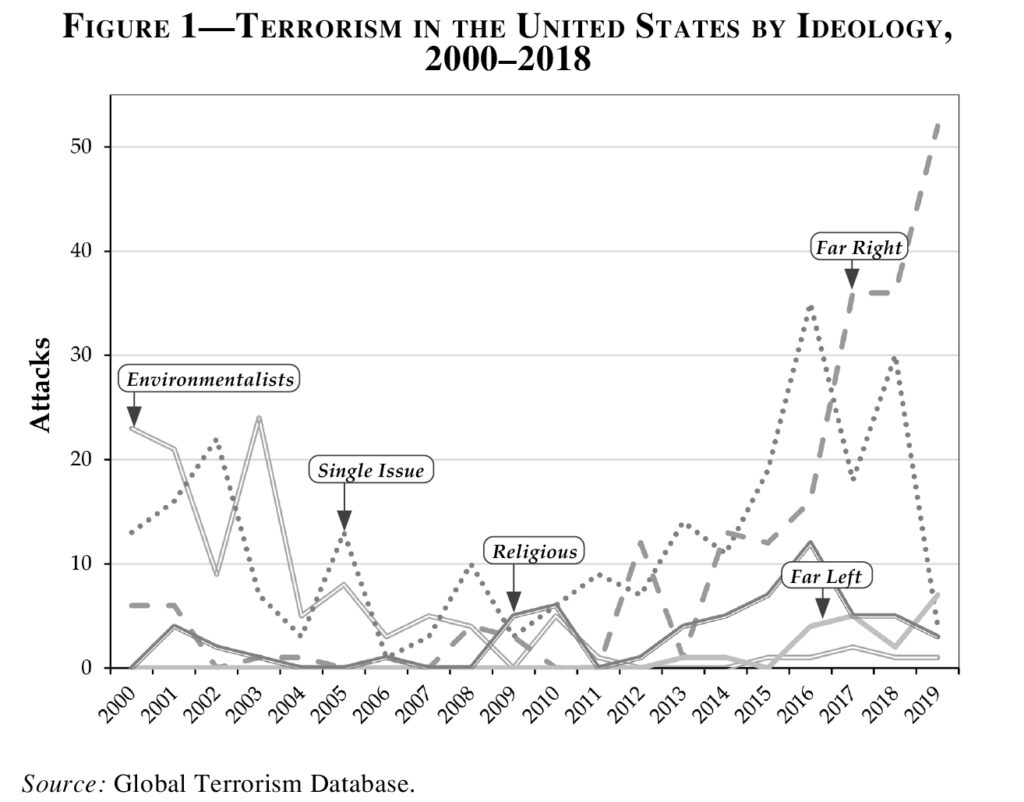
The other subgroup prone to violence comprises those who feel threatened by either women or minorities. The polling on them is not clear. Separate surveys conducted past the American Enterprise Establish and academics in 2022 and 2022 found a bulk of Republicans agreeing that "the traditional American style of life is disappearing so fast" that they "may have to use force to save it." Respondents who believed that whites faced greater discrimination than minorities were more than likely to concord.6 Scholars Nathan Kalmoe and Lilliana Stonemason found that white Republicans with college levels of minority resentment were more than likely to run into Democrats as evil or subhuman (beliefs thought to reduce inhibitions to violence). However, despite these feelings, the racially resentful did not stand out for endorsing violence against Democrats. Instead, the people virtually likely to support political violence were both Democrats and Republicans who espoused hostility toward women.7 A sense of racial threat may be priming more conservatives to limited greater resentment in ways that normalize violence and create a more permissive atmosphere, while men in both parties who feel particularly aggrieved toward women may be nigh willing to human activity on those feelings.
The bedrock idea uniting correct-wing communities who condone violence is that white Christian men in the United States are nether cultural and demographic threat and require defending—and that it is the Republican Party and Donald Trump, in detail, who volition safeguard their mode of life.eight This pattern is similar to that of political violence in the nineteenth-century United States, where partisan identity was conflated with race, ethnicity, religion, and immigration status; many U.Southward.-built-in citizens felt they were losing cultural power and status to other social groups; and the violence was committed not by a few deviant outliers, only by many otherwise ordinary citizens engaged in normal borough life.
Changing social dynamics were the obvious spur for this violence, but it often yielded political outcomes. The ambivalence incentivized and enabled politicians to play with fire, deliberately provoking violence while claiming plausible deniability. In the 1840s and 1850s, from Maine and Maryland to Kentucky and Louisiana, the Know-Naught party incited white Protestants to riot against generally Catholic Irish and Italian immigrants (seen as both nonwhite and Democratic Party voters). When the Know-Nothings collapsed in 1855 in the North and 1860 in the South, anti-Catholic violence of a sudden plummeted, despite continued bigotry. In the South, white supremacist violence was blamed on racism, just the timing was linked to elections. After the Supreme Courtroom ruled in 1883 that the federal authorities lacked jurisdiction over racist terror, overturning the 1875 Civil Rights Deed, violence became an open up campaign strategy for the Democratic Party in multiple states. Lynchings were used in a similar mode. While proximate causes were social and economic, their time and identify were primed by politics: Lynchings increased prior to elections in competitive counties.9 Democratic Party politicians used racial rhetoric to amplify anger, then allowed violence to occur, to convince poor whites that they shared more than in common with wealthy whites than with poor blacks, preventing the Populist and Progressive Parties from uniting poor whites and blacks into a single voting base. Every bit Jim Crow laws enshrined Democratic one-party control, lynchings were not needed past politicians. Their numbers fell swiftly; they were no longer linked to elections.10
Run a risk Factors for Election Violence
Globally, four factors elevate the risk of election-related violence, whether carried out directly by a political party through land security or armed party youth wings, outsourced to militias and gangs, or perpetrated past ordinary citizens: 1) a highly competitive ballot that could shift the balance of power; two) partisan division based on identity; 3) electoral rules that enable winning past exploiting identity cleavages; and 4) weak institutional constraints on violence, specially security-sector bias toward ane group, leading perpetrators to believe they will non be held accountable for violence.xi
The rise of the Hindu-nationalist Bharatiya Janata Party (BJP) illustrates this dynamic. In 2002, a train fire killed Hindu pilgrims returning to Gujarat, India, from a contested sitein Ayodhya. An anti-Muslim pogrom erupted. Republic of india's current prime number minister, the BJP's Narendra Modi, was then master minister of Gujarat. During three days of violence directed almost entirely against Muslims, he allowed the police to stand up by and afterward refused to prosecute the rioters. The political party won state legislative elections later that year past exploiting Hindu-Muslim tensions to pry Hindu voters from the Congress Party. The party has since stoked ethnic riots to win in contested areas across the country, and Modi reprised the strategy as prime government minister.12
In India's winner-take-all balloter system, mob violence tin potentially swing elections. Though fueled past social grievance, mob violence is susceptible to political manipulation. This is the class of balloter violence most similar what the United States is experiencing, and it is particularly dangerous. Social movements have goals of their own. Though they may besides serve partisan purposes, they can move in unintended directions and are difficult to control.
Today, the risk factors for balloter violence are elevated in the The states, putting greater pressure on institutional constraints.
Highly competitive elections that could shift the balance of ability: Heightened political competition is strongly associated with electoral violence. Only when outcomes are uncertain only shut is there a reason to resort to violence. For much of U.Due south. history, one political party held legislative power for decades. Yet since 1980, a shift in command of at least one firm of Congress was possible—and since 2010, elections have seen a level of competition not seen since Reconstruction (1865–77).thirteen
Partisan partition based on identity: Up to the 1990s, many Americans belonged to multiple identity groups—for example, a union member might take been a conservative, religious, Southern homo who withal voted Democratic. Today, Americans have sorted themselves into 2 broad identity groups: Democrats tend to live in cities, are more likely to be minorities, women, and religiously unaffiliated, and are trending liberal.Republicans mostly live in rural areas or exurbs and are more likely to exist white, male, Christian, and conservative.14 Those who hold a cross-cut identity (such every bit blackness Christians or female Republicans) generally cleave to the other identities that align with their partisan "tribe."
Equally political psychologist Lilliana Mason has shown, greater homogeneity inside groups with fewer cross-cut ties allows people to grade clearer in- and out-groups, priming them for conflict. When many identities align, belittling whatsoever one of them tin can trigger humiliation and anger. Such feelings are heightened past policy differences merely are not nearly policy; they are personal, and thus are more powerful. These existent cultural and belief differences are at the centre of the cultural conflicts in the United States.
U.S. political party and electoral institutions are intensifying rather than reducing these identity cleavages. The alignment of racial and religious identity with political party is non random. Sorting began after the passage of the Civil Rights Act in 1965 as whites who disagreed with racial equality fled the Democratic Party. A second moving ridge—the so-called Reagan Democrats, who had varied ideological motivations, followed in 1980 and 1984. A third moving ridge, pushed away from the Democratic Party by the election of Barack Obama and attracted by Trump'south 2022 presidential entrada, drew previous swing voters who were peculiarly probable to define "Americanness" as white and Christian into the Republican Party.15
A 2022 Pew Research Center poll found that 32 percent of U.S. citizens believed that to be a "existent American," ane must exist a U.S.-born Christian. But amongst Trump's chief voters, according to a 2022 Voter Report Group assay, 86 percent idea information technology was "very important" to have been born in the United states of america; 77 percentage believed that one must be Christian; and 47 percent idea i must also be "of European descent."16 Co-ordinate to Democracy Fund voter surveys, during the 2022 primaries, many economic conservatives, libertarians, and other traditional Republican groups did non share these views on citizenship. By 2020, yet, white identity voters fabricated upwardly an fifty-fifty larger share of the Republican base of operations. Moreover, their influence is greater than their numbers considering in the current U.South. context—where identities are so fixed and political polarization is and then intense—swing voters are rare, so it is more than cost-effective for campaigns to focus on turning out reliable voters. The easiest way to do this is with emotional appeals to shared identities rather than to policies on which groups may disagree.17 This is truthful for both Republicans and Democrats.
The Democratic Party's base of operations, even so, is extremely heterogeneous. The political party must therefore residuum competing demands—for instance, those of less reliable young "woke" voters with those of highly reliable African American churchgoers, or those of more-bourgeois Mexican American men with those of progressive activists. In contrast, the Republican Party is increasingly homogenous, which allows campaigns to target appeals to white, Christian, male person identities and the traditional social bureaucracy.
The emergence of big numbers of Americans who can be prompted to commit political violence by a variety of social events is thus partially an accidental byproduct of normal politics in highly politically sorted, psychologically abnormal times. Fifty-fifty in normal times, people more readily rally to their group's defense when it is under attack, which is why "theyare out to takeyour x" is such a time-honored fundraising and get-out-the-vote message. Usually, such tactics merely raise polarization. But when individuals and societies are highly sorted and stressed, the effects can be much worse. Inequality and loneliness, which were endemic in the United States even before the covid-nineteen pandemic and accept just gotten worse since, are factors highly correlated with violence and assailment. Contagious disease, meanwhile, has led to xenophobic violence historically.
The confluence of these factors with sudden social-distancing requirements, closures of businesses and public spaces, and unusually intrusive pandemic-related government measures during an election year may have pushed the more psychologically fragile over the border. Psychologists have establish that when more than homogenous groups with meaning overlap in their identities face a sense of grouping threat, they respond with deep anger. Acting on that anger can restore a sense of bureau and self-esteem and, in an environment in which violence is justified and normalized, peradventure fifty-fifty win social approving.18
The sorts of racially coded political messages that accept been in use for decades will be received differently in a political party whose composition has altered to include a greater percent of white identity voters. Those who experience that their ascendant status in the social hierarchy is nether assault may respond violently to perceived racial or other threats to their status at the top. But those lower on the social ladder may also resort to violence to assert authorisation over (and thus psychological separation from) those at the bottom—for example, minority men over women or other minorities, i religious minority over another, or white women over minority women. Antisemitism is growing among the young, and exists on the left, but is far stronger on the right, and is particularly salient amongst racial minorities who lean right.nineteen On the far-left, fierce feelings are emerging from the aforementioned sense of group threat and defence, simply in mirror-prototype: Those well-nigh willing to dehumanize the right are people who see themselves as defending racial minorities.
Republicans and Democrats have been espousing similar views on the acceptability of violence since 2017, when Kalmoe and Mason began collecting monthly information.
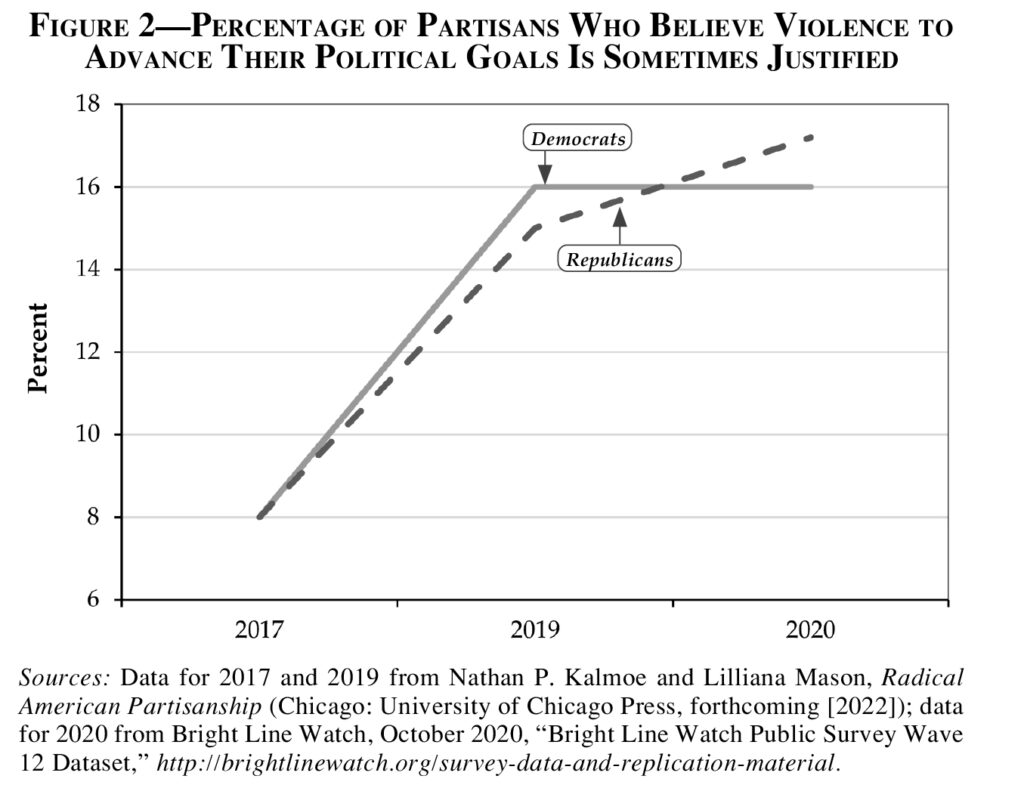
Between 2022 and 2020, Democrats and Republicans were extremely close in justifying violence, with Democrats slightly more than prone to condone violence—except in Nov 2019, the month before Trump'south first impeachment, when Republican support for violence spiked. Both sides too expressed similarly loftier levels of dehumanizing thought: 39 percentage of Democrats and 41 percent of Republicans saw the other side as "downright evil," and 16 percent of Democrats and 20 percentage of Republicans said that their opponents were "like animals." Such feelings can point to psychological readiness for violence. Separate polling found lower but still comparable levels: four percent of Democrats and 3 per centum of Republicans believed in October 2022 that attacks on their political opponents would be justified if their party leader alleged the election was stolen; half dozen percent of Democrats and 4 percent of Republicans believed property damage to be adequate in such a case.20
The parallel attitudes suggest that partisan sorting and social pressures were working every bit on all Americans, although Republicans may have greater tolerance for online threats and harassment of opponents and opposition leaders.21 However bodily incidents of political violence, while rising on both sides, take been vastly more prevalent on the right. Why has the right been more willing to act on fierce feelings?
The clue lies in the sudden shift in attitudes in October 2020, when after maintaining similarity for years, Republicans' endorsements of violence suddenly leapt across every one of Kalmoe and Mason's questions regarding the acceptability of violence; findings that were repeated in other polling.22 In Jan 2020, 41 percentage of Republicans agreed that "a time will come when patriotic Americans have to accept the constabulary into their own hands"; a year afterwards, after the January 6 coup, 56 percentage of Republicans agreed that "if elected leaders will non protect America, the people must do it themselves fifty-fifty if it requires taking violent action."23 Moral disengagement also spiked: By February 2021, more than two-thirds of Republicans (and half of Democrats) saw the other political party as "downright evil,"; while 12 percent more Republicans believed Democrats were less than human than the other style around.24
The false narrative of a stolen 2022 election conspicuously increased support for political violence. Those who believed the ballot was fraudulent were far more likely to endorse coups and armed citizen rebellion; by February 2021, a quarter of Republicans felt that information technology was at least "a little" justified to take over land government buildings with violence to advance their political goals.25 This politically driven imitation narrative points to the office of politicians since 2022 in fueling the difference in violence between right and left. As has been found in Israel and Frg, domestic terrorists are emboldened by the belief that politicians encourage violence or that authorities volition tolerate it.26
It is non uncommon for politicians to incite communal violence to affect electoral outcomes. In northern Republic of kenya, voters call this "war past remote control." Incumbent leaders who fear losing are particularly prone to using balloter violence to intimidate potential opponents, build their base, affect voting behavior and election-twenty-four hour period vote counts, and, failing all that, to keep themselves relevant or at least out of jail.27 Communal violence tin articulate opposition voters from contested areas, altering the demographics of balloter districts, as happened in Kenya'southward Rift Valley in 2007 and the U.S. Southward during Reconstruction. Violent intimidationtin keep voters away from the polls, as has occurred since the 1990s in Bangladesh; from the 1990s through 2013 in Pakistan; and in the U.S. Due south in the 1960s.
Communal violence often flares in contested districts where it is politically expedient, every bit in Kenya and India. Likewise, political violence in the United States has been greatest in suburbs where Asian American and Hispanic American immigration has been growing fastest, specially in heavily Democratic metropoles surrounded by Republican-dominated rural areas. These areas, where white flight from the 1960s is coming together demographic change, are areas of social contestation. They are too politically contested swing districts. Near of the arrested Jan 6 insurrectionists hailed from these areas rather than from Trump strongholds.28 Postelection violence can also be useful to politicians. They can dispense aroused voters who believe their votes were stolen into using violence to influence or block final counts or proceeds leverage in power-sharing negotiations, equally occurred in Kenya in 2007 and Afghanistan in 2019.
Not all political violence directly serves an electoral purpose. Using violence to defend a grouping bonds members to the group. Thus violence is a particularly effective way to build voter "intensity." In 1932, young blackness-clad militants of the British Union of Fascists roamed England'southward streets, picking fights and harassing Jews. The leadership of the nascent party realized that its profile grew whenever the "blackshirts" got into violent confrontations. Two years after, the party held a rally of nearly 15-chiliad people that became a vicious melee between blackshirts and antifascist protestors. After the clash (which was not fully spontaneous), people queued to bring together the party for the adjacent two days and nights and membership soared.29 Every bit every organizer knows, effective mobilization requires keeping supporters engaged. Given the office of gun rights to Republican identity, armed rallies can mobilize supporters and expand fundraising. Yet even peaceful rallies of crowds conveying automatic weapons can intimidate people who concord opposing views.
Finally, politicians may personally benefit from vehement mobilization that is not election-related. In South Africa, former president Jacob Zuma spent years cultivating ties with violent criminal groups in his home country of Kwa-Zulu Natal.30 When he was out of office and on trial for abuse and facing jail time for contempt of court, he activated those connections to spur a round of violence and looting on a scale not seen in South Africa since apartheid. Vast inequality, unemployment, and other social causes allowed for plausible deniability—many looters with no political ties were just joining in the fracas. Zuma has, every bit of this writing, avoided imprisonment due to undisclosed "medical reasons."
Electoral rules enable winning by exploiting identity cleavages: The fissures in divided societies such as the U.s.a. can be either mitigated or enhanced by electoral systems. The U.S. electoral organisation comprises features that are correlated with greater violence globally. Winner-take-all elections are peculiarly prone to violence, possibly because small numbers of voters tin shift outcomes. 2-political party systems are as well more correlated with violence than are multiparty systems, mayhap because they create us-them dynamics that deepen polarization.31 Although multiparty systems allow more-extreme parties to proceeds representation, such every bit Alternative for Frg or Golden Dawn in Greece, they also enable other parties to piece of work together confronting a common threat. The U.S. organization is more brittle. A ii-party organization tin forestall the representation of fringe views, every bit occurred for years in the Us—for example, American Contained Political party candidate George Wallace won 14 percent of the popular vote in 1968 but no representation. Still because political party primaries tend to be depression-turnout contests with highly partisan voters, minor factions tin can proceeds outsized influence over a mainstream party. If that happens, extreme politicians can proceeds control over half of the political spectrum—leaving that party's voters nowhere to turn.
Weak institutional constraints on violence: The United States suffers from iii especially concerning institutional weaknesses today—the challenge of adjudicating disputes between the executive and legislative branches inherent in presidential majoritarian systems, recent legal decisions enhancing the electoral ability of country legislatures, and the politicization of law enforcement and the courts.
Juan Linz famously noted that apart from the Us, few presidential majoritarian systems had survived as continuous democracies. One key reason was the trouble of resolving disputes between the executive and legislative branches. Considering both are popularly elected, when they are held past unlike parties stalemates between the two invite resolution through violence. Such a dynamic drove state-level electoral violence throughout the nineteenth century, not simply in the Reconstruction Due south, simply also in Pennsylvania, Maine, Rhode Island, and Colorado. Information technology is thus specially concerning that in the last year, nine states take passed laws to requite greater power to partisan bodies, particularly state legislatures.32 The U.S. Supreme Court has besides made several recent decisions vesting greater power over elections in country legislatures. These trends are weakening institutional guardrails confronting time to come political violence.
When law and justice institutions are believed to lean toward one party or side of an identity cleavage, political violence becomes more than probable. International cases reveal that groups that believe they can utilize violence without consequences are more probable to exercise so. The U.S. justice organisation, police, and armed forces are far more professional and less politicized than those of about developing democracies that face widespread balloter violence. Longstanding perceptions that constabulary favor one side are supported by Armed Conflict Location and Effect Data Project (ACLED) data showing that police used far greater force at left-wing protests than at right-wing protests throughout 2020. Despite this conservative ideological tilt, party affiliation and feelings were more than complicated: Police enforcement was also a target of correct-wing militias, and partisan amalgamation (based on donations) had previously been mixed due to wedlock membership and other cross-cut identities that connected police to the Democratic Political party. In 2020, nevertheless, donations from individual constabulary enforcement officers to political parties increased, and they tilted far toward the Republican Party, suggesting that the polarizing events of 2022 take led them to sort themselves to the right and deepen their partisanship.33
How to Counter the Trends
Interventions in 5 cardinal areas could help defuse the threat of political violence in the United States: 1) election credibility, 2) electoral rules, three) policing, four) prevention and redirection, and five) political speech. The steps best taken depend on who is in power and who is committing the violence. Technical measures to enhance election credibility and train police can reduce inadvertent violence from the state. Only such technical solutions will fail if the party in ability is inciting violence, as happens mostly. In that instance, behind-the-scenes efforts to help parties and leaders strike deals or mediate grievances can sometimes keep violence at bay. In Kenya, for example, 2 opposing politicians accused of leading election violence in 2007 joined forces to run every bit president and vice-president; their alliance enabled a peaceful election in 2013. Ironically, strong institutions, depression levels of corruption, and reductions in institutionalized methods of elite deal-making (such as Congressional earmarks) make such bargains more than hard in the United States. However, the United states of america is helped by its unusually high level of federalism in terms of elections and police force enforcement, considering if i part of "the state" is acting against reform, it may still be possible at some other level.
More credible elections: While there was no widespread fraud in the 2022 U.S. elections, international election experts agree that the U.S. balloter system is antiquated and prone to failure. The proposed Freedom to Vote Act, which enhances cybersecurity, protects election officers, provides a paper trail for ballots, and provides proper training and funding for ballot administration, among other measures, could offer the sort of bipartisan compromise that favors neither side and would shore up a problematic system. Merely if information technology is turned into a political cudgel, as is likely, it volition fail to reassure voters, despite its fantabulous provisions.
Irresolute the electoral rules: Whether politicians apply violence every bit a campaign strategy is shaped by the nature of the electoral system. A seminal study on India past Steven Wilkinson suggests that where politicians need minority votes to win, they protect minorities; where they do not, they are more likely to incite violence.34 By this logic, Section 2 of the U.S. Voting Rights Act of 1965, which allows for gerrymandering majority-minority districts to ensure African American representation in Congress, may inadvertently incentivize violence by making minority votes unnecessary for Republican wins in the remaining districts . While minority representation is its own valuable democratic goal, creating districts where Republicans need minority votes to win—and where Democrats need white votes to win—might reduce the likelihood of violence.
Whether extremists get elected and whether voters feel represented or get disillusioned with the peaceful process of democracy tin also exist affected by electoral-system design. Thus postconflict countries often redesign balloter institutions. For instance, a major plank of the 1998 Practiced Friday Agreement that ended the Troubles in Northern Ireland involved introducing a type of ranked-choice voting with multimember districts to increment a sense of representation. There are organizations in the United states of america today that are advocating various reform measures—for instance, eliminating primaries and introducing forms of ranked-choice voting or requiring lawmakers to win a bulk of votes to be elected (currently the example in only a handful of states)—that could effect in fewer extremists gaining power while increasing voter satisfaction and representation.
Fairer policing and accountability: Even in contexts of high polarization, external deterrence and societal norms mostly keep people from resorting to political violence. Partisans who are tempted to act violently should know that they will exist held accountable, fifty-fifty if their party is in power. Minority communities, meanwhile, need assurance that the land will defend them.
A number of constabulary-reform measures could assistance. Police training in de-escalation techniques and nonviolent protest and crowd control, support for officers nether psychological strain, improved intelligence collection and sharing regarding domestic threats, and more-representative police forces would all assist deter both political violence and law brutality. Publicizing such efforts would demonstrate to society that the regime will not tolerate political violence.
Meanwhile, swift justice for violence, incitement, and credible threats against officials—speedy jail sentences, for instance, even if brusk—is besides crucial for its signaling and deterrent value. So are laws that criminalize harassment, intimidation, and political violence.
Prevention and redirection: Lab experiments have found that internal norms tin can be reinforced by "inoculating" individuals with warnings that people may i day try to indoctrinate them to extremist behavior or recruit them to participate in acts of political violence. Considering no i likes to exist manipulated, the forewarned organize their mental defenses against it. The technique seems promising for preventing younger people from radicalization, though it requires more testing among older partisans whose beliefs are strongly set.35
A pregnant portion of those engaged in far-correct violence are also nether mental distress. People searching online for far-right violent extremist content are 115 percent more likely to click on mental-health ads; those undertaking planned detest crimes testify greater signs of mental illness than does the general offender population.36 Groups such as Moonshot CVE are experimenting with targeted ads that can redirect people searching for extremist content toward hotlines for depression and loneliness and assistance for leaving violent groups.
Political speech: When political leaders denounce violence from their ain side, partisans listen. Experiments using quotes from Biden and Trump show that leaders' rhetoric has the ability to de-escalate and deter violence—if they are willing to speak against their ain side.37
Long-term trends in social and political-political party organization, isolation, distrust, and inequality, capped by a pandemic, take placed individual psychological health and social cohesion nether immense strain. Kalmoe and Bricklayer's surveys found that in February 2021, a fifth of Republicans and 13 percent of Democrats—or more 65 meg people—believed immediate violence was justified. Even if only a tiny portion are serious, such large numbers put a country at take chances of stochastic terrorism—that is, information technology becomes statistically virtually certain that someone (though it is incommunicable to predict who) somewhere will act if a public effigy incites violence.
Thus while social factors may have created the conditions, politicians have the match to light the tinder. In recent years, some candidates on the correct take been specially willing to use violent spoken language and engage with groups that spread hate. Yet Democrats are not immune to these trends. Far-left violence is far lower than on the correct, but ascension. The firearm industry'southward trade association found that, in 2020, twoscore percent of all legal gun sales were to outset-time buyers, and 58 percent of those 5-one thousand thousand new owners were women and African Americans.38 Kalmoe and Stonemason'due south Feb 2022 polling found that 11 percent of Democrats and 12 percent of Republicans agreed that it was at least "a little" justified to kill opposing political leaders to advance their own political goals. With both the left and the right increasingly armed, viewing the other side as evil or subhuman, and believing political violence to exist justified, the possibility grows of tit-for-tat street warfare, similar the clashes between antifascist protesters and Proud Boys in Portland, Oregon, from 2022 through this writing. If Democrats accept been less likely to act on these beliefs, it is likely considering Autonomous politicians have largely and vocally spoken out confronting violence.
Although political violence in the United states of america is on the rise, information technology is still lower than in many other countries. Once violence begins, yet, it fuels itself. Far from making people turn away in horror, political violence in the present is the greatest gene normalizing it for the future. Preventing a downwards spiral is therefore imperative.
NOTES
1. "Election Officials Under Attack: How to Protect Administrators and Safeguard Democracy," Brennan Middle for Justice, 16 June 2021,world wide web.brennancenter.org/sites/default/files/2021-06/BCJ-129%20ElectionOfficials_v7.pdf; "Documenting and Addressing Harassment of Election Officials," California Voter Foundation, June 2021,world wide web.calvoter.org/sites/default/files/cvf_addressing_harassment_of_election_officials_report.pdf; Zach Montellaro, "'Center of the Maelstrom': Election Officials Grapple with 2020's Long Shadow," Politician,18 August 2021.
2. See the Global Terrorism Database maintained by the National Consortium for the Study of Terrorism and Responses to Terrorism at the University of Maryland, the dataset of extremist far-correct vehement incidents maintained past Arie Perliger at the Academy of Massachusetts, Lowell, and FBI information on hate crimes.
3. Robert O'Harrow, Jr., Andrew Ba Tran, and Derek Hawkins, "The Rise of Domestic Extremism in America,"Washington Mail,12 April 2021.
seven. Nathan P. Kalmoe and Lilliana Stonemason,Radical American Partisanship: Mapping Violent Hostility, Its Causes, and the Consequences for Democracy(Chicago: University of Chicago Press, forthcoming [2022]), 105, 109.
9. Susan Olzak, "The Political Context of Contest: Lynching and Urban Racial Violence, 1882–1914,"Social Forces 69 (December 2020): 395–421; Ryan Hagen, Kinga Makovi, and Peter Bearman, "The Influence of Political Dynamics on Southern Lynch Mob Formation and Lethality,"Social Forces 92 (December 2013): 757-87.
10. Brad Epperly, Christopher Witko, Ryan Strickler, and Paul White, "Dominion past Violence, Rule by Law: Lynching, Jim Crow, and the Standing Evolution of Voter Suppression in the U.S.,"Perspectives on Politics18 (September 2020): 756-69.
eleven. Sarah Birch, Ursula Daxecker, and Kristine Hӧglund, "Electoral Violence: An Introduction,"Journal of Peace Inquiry 57 (January 2020): three–14.
12. Steven I. Wilkinson,Votes and Violence: Electoral Contest and Ethnic Riots in India (Cambridge: Cambridge University Printing, 2004).
13. Frances Due east. Lee,Insecure Majorities:Congress and the Perpetual Campaign (Chicago: University of Chicago Press, 2016).
xiv. Lilliana Mason,Uncivil Understanding: How Politics Became Our Identity (Chicago: Academy of Chicago Press, 2018).
15. Tyler T. Reny, Loren Collingwood, and Ali A. Valenzuela, "Vote Switching in the 2022 Election: How Racial and Immigration Attitudes, Not Economics, Explain Shifts in White Voting,"Public Stance Quarterly83 (Jump 2019): 91–113; John Sides, Michael Tesler, and Lynn Vavreck,Identity Crunch: The 2022 Presidential Campaign and the Battle for the Significant of America(Princeton: Princeton Academy Press, 2018).
17. Costas Panagopoulos, "All Almost That Base: Changing Campaign Strategies in U.S. Presidential Elections,"Party Politics22 (March 2016): 179–90.
18. Pablo Fajnzylber, Daniel Lederman, and Norman Loayza, "Inequality and Violent Crime," Periodical of Law and Economics 45 (April 2002): i–39; James V. P. Cheque, Daniel Perlman, and Neil M. Malamuth, "Loneliness and Aggressive Behavior,"Journal of Social and Personal Relationships 2 (September 1985): 243–52; Mark Schaller and Justin H. Park, "The Behavioral Allowed System (and Why Information technology Matters),"Electric current Directions in Psychological Science xx (Apr 2011): 99–103.
20. Kalmoe and Mason,Radical American Partisanship; Noelle Malvar et al., "Democracy for President: A Guide to How Americans Can Strengthen Republic During a Divisive Election," More in Common, October 2020,https://democracyforpresident.com/topics/election-violence.
21. The Democracy Fund's 2022 VOTER Survey shows ten-signal gaps for each in December 2019; yet, monthly Kalmoe and Stonemason polling shows no gap, and Bright Line Watch polling in 2022 shows splits of less than 6 and three pct for identically worded questions.
22. Kalmoe and Bricklayer,Radical American Partisanship,83–xc.
23. Bartels, "Indigenous Antagonism Erodes Republicans' Delivery to Democracy"; Cox, "Back up for Political Violence."
24. Kalmoe and Mason,Radical American Partisanship,86.
25. Kalmoe and Mason,Radical American Partisanship, 164, 90.
27. Ken Menkhaus,Conflict Assessment: Northern Republic of kenya and Somaliland(Copenhagen: Danish Deming Grouping, 2015), 42; Thad Dunning, "Fighting and Voting: Violent Conflict and Electoral Politics,"Periodical of Disharmonize Resolution 55 (June 2011): 327–39.
29. Martin Pugh, "The British Spousal relationship of Fascists and the Olympia Debate," Historical Journal 41 (June 1998): 529–42.
31. G. Bingham Powell, Jr., "Political party Systems and Political Organization Operation: Voting Participation, Government Stability and Mass Violence in Contemporary Democracies,"American Political Science Review75, no. 4 (1981): 861–79; Hanne Fjelde and Kristine Höglund, "Electoral Institutions and Balloter Violence in Sub-Saharan Africa,"British Journal of Political Science 46 (Apr 2016): 297–320.
33. Phillip Bump, "Law Made a Lot More than Contributions in 2022 Than Normal—Mostly to Republicans,"Washington Post,25 February 2021.
34. Wilkinson,Votes and Violence.
35. Kurt Braddock, "Vaccinating Against Hate: Using Inoculation to Confer Resistance to Persuasion past Extremist Propaganda,"Terrorism and Political Violence (2019), 1–23.
36. "Mental Wellness and Violent Extremism," Moonshot CVE, 28 June 2018,https://moonshotteam.com/mental-health-vehement-extremism; Profiles of Individual Radicalization in the United States (PIRUS) dataset, Global Terrorism Database.
37. Kalmoe and Mason,Radical American Partisanship,180-87; Matthew A. Baum and Tim Groeling, "Shot by the Messenger: Partisan Cues and Public Stance Regarding National Security and State of war,"Political Beliefs 31 (June 2009): 157–86; Susan Birch and David Muchlinski, "Electoral Violence Prevention: What Works?"Democratization 25 (April 2018): 385–403.
Source: https://www.journalofdemocracy.org/articles/the-rise-of-political-violence-in-the-united-states/
0 Response to "Ryans Being a Little Birch Again Meme"
Post a Comment