Beef Not Allowed to Eat India
All of Republic of india's most widely good religions have dietary laws and traditions. For example, Hindu texts often praise vegetarianism, and Hindus may as well avoid eating beef because cows are traditionally viewed as sacred. Muslim teachings, meanwhile, prohibit pork.
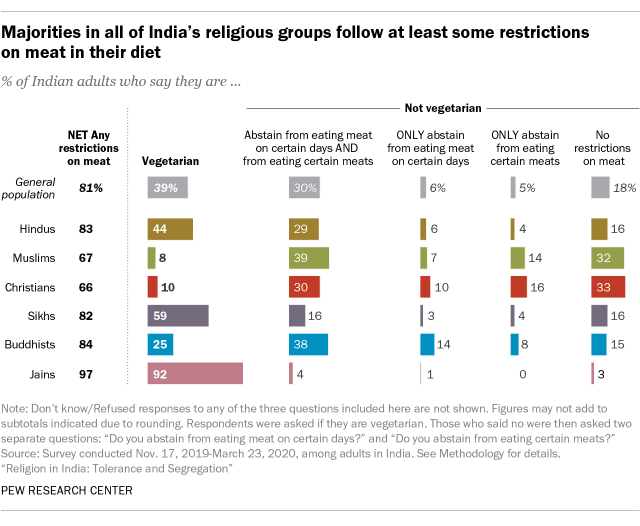
The vast majority of Indian adults (81%) follow some restrictions on meat in their diet, including refraining from eating certain meats, non eating meat on certain days, or both. However, most Indians do not abjure from meat altogether – just 39% of Indian adults describe themselves as "vegetarian," according to a new Pew Research Center survey. (While in that location are many means to define "vegetarian" in India, the survey left the definition upwards to the respondent.)
Pew Research Center conducted this analysis to improve empathise how dietary laws and traditions in India are tied to religious identities, beliefs and attitudes. It is based on the 2021 report "Religion in India: Tolerance and Segregation," the Center'south about comprehensive, in-depth exploration of Indian public opinion to date. For this written report, nosotros completed 29,999 face up-to-face interviews in 17 languages with adults ages xviii and older living in 26 Indian states and iii marriage territories. The sample included interviews with 22,975 Hindus, 3,336 Muslims, i,782 Sikhs, 1,011 Christians, 719 Buddhists and 109 Jains. An additional 67 respondents vest to other religions or are religiously unaffiliated. Interviews for this nationally representative survey were conducted from November. 17, 2019, to March 23, 2020.
Respondents were selected using a probability-based sample design that would allow for robust assay of all major religious groups in India, besides as all major regional zones. Half dozen groups were targeted for oversampling as part of the survey design: Muslims, Christians, Sikhs, Buddhists, Jains and those living in the Northeast region. Information was weighted to account for the different probabilities of option among respondents and to align with demographic benchmarks for the Indian adult population from the 2011 census.
Here are the questions used for this report, forth with responses, and its methodology.
Among Bharat'south six largest religious groups, some are much more probable than others to abstain from meat. For case, the vast majority of Jains say they are vegetarian (92%), compared with just 8% of Muslims and ten% of Christians. Hindus fall in between (44%).
Withal, even among groups with low rates of vegetarianism, many Indians restrict their meat consumption. For example, roughly 2-thirds of Muslims (67%) and Christians (66%) avoid meat in some manner, such as refraining from eating certain meats, not eating meat on sure days, or both. Among Hindus, in addition to the 44% who are vegetarian, another 39% follow some other brake on meat consumption.
Many Jains avoid non but meat but also root vegetables to avoid destroying the entire found, which is seen as a form of violence in Jain theology. Well-nigh two-thirds of Jains (67%) say they abjure from eating root vegetables such equally garlic and onions (staples in many Indian cuisines). Even amid Hindus and Sikhs, roughly i-in-five say they do not swallow root vegetables (21% and 18%, respectively). Hindu vegetarians are about evenly divided between those who eat root vegetables and those who exercise not.
Fasting is another mutual dietary practise in India. About three-quarters of Indians overall (77%) fast, including most eight-in-ten or more among Muslims (85%), Jains (84%) and Hindus (79%). Smaller majorities of Christians and Buddhists fast (64% and 61%, respectively), while Sikhs are the least likely to fast (28%).
Religious groups in Bharat fast to marking dissimilar occasions. Muslims, for example, fast during the month of Ramadan each yr, while other Indians fast on certain days of the week and to mark important life events. Hindus, especially in the South, may fast before every Skanda Sashti – a twenty-four hour period devoted to Skanda, the god of state of war.
In addition to request about personal dietary habits, the survey asked whether respondents would always eat food in the abode of someone – or at a function hosted by people – whose religion has different rules virtually food than their own. Overall, Indians are evenly split on these questions, just at that place are broad variations by group.
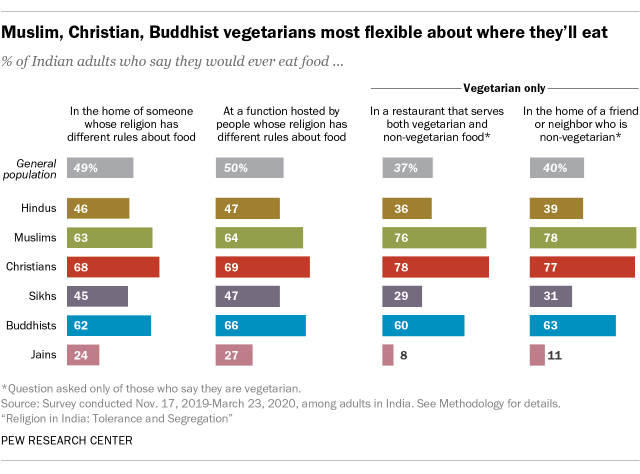
Roughly a quarter of Jains say they would eat in a home (24%) or at a function (27%) where the host's religious rules about food differ from their own, while slightly fewer than half of India'due south Hindus and Sikhs say the same. In dissimilarity, 6-in-ten or more Buddhists, Muslims and Christians would be willing to swallow at a place with different rules nigh food.
At that place is a like pattern when asking vegetarians near eating in different situations. Vegetarian Jains are the least likely to say they would ever consume food in a eating house that serves both non-vegetarian and vegetarian food or in the home of a friend who is non vegetarian. In contrast, Buddhists, Muslims and Christians are the most likely to say this. Hindu and Sikh vegetarians, meanwhile, autumn somewhere in the middle, with 3-in-10 or more saying they would always eat food in these non-vegetarian settings.
Not just practise religious dietary traditions impact Indians' day-t0-24-hour interval lives, but they also influence concepts of religious identity and belonging.
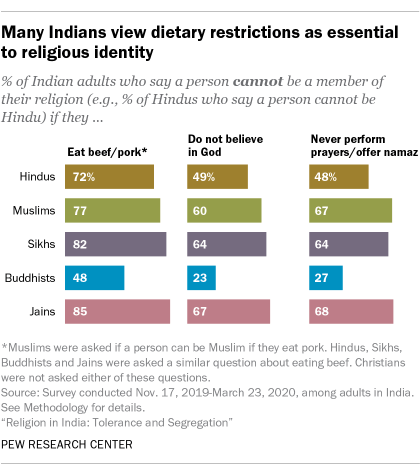
In fact, Indian adults are generally more than likely to say that following dietary restrictions is a requirement for religious identity than to say that belief in God and prayer are essential. For instance, 72% of Hindus say someone cannot be Hindu if they swallow beef, simply fewer express the same sentiment about someone who does not believe in God (49%) or never prays (48%).
Among Muslims, Sikhs and Jains, fifty-fifty greater shares say that following dietary rules is essential to religious identity: 77% of Muslims say a person cannot be Muslim if they eat pork, compared with smaller shares who say this virtually a person who does not believe in God (60%) or never prays (67%). More eight-in-10 Sikhs (82%) and Jains (85%) say that a person cannot exist truly a fellow member of their faith if they consume beefiness. Buddhists are split on the issue, with well-nigh half expressing that someone cannot be a Buddhist if they eat beef. (Christians were not asked about eating meat and Christian identity.)
Note: Here are the questions used for this report, along with responses, and its methodology.

Manolo Corichi is a enquiry assistant focusing on religion research at Pew Research Center.
Source: https://www.pewresearch.org/fact-tank/2021/07/08/eight-in-ten-indians-limit-meat-in-their-diets-and-four-in-ten-consider-themselves-vegetarian/#:~:text=All%20of%20India's%20most%20widely,teachings%2C%20meanwhile%2C%20prohibit%20pork.
0 Response to "Beef Not Allowed to Eat India"
Post a Comment